Notes – Polynomials
A polynomial function, , is an algebraic expression that takes the form
where the coefficients
are real numbers, and the powers
are non- negative integers
The degree of a polynomial is the highest power of
in the expression.
SYNTHETIC DIVISION
Dividing a cubic polynomial by a linear polynomial .
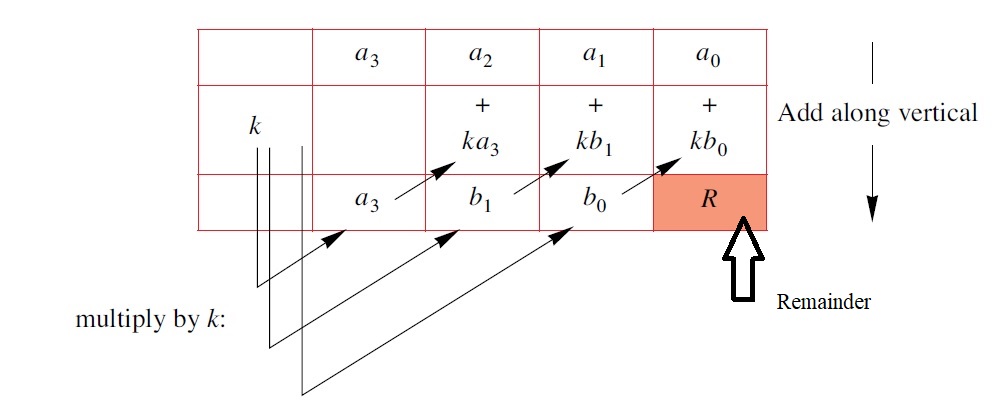
Quotient = , Remainder = R
THE REMAINDER THEOREM
For any polynomial , the remainder when divided by is .
Q. Find the remainder when is divided by .
Remainder =
THE FACTOR THEOREM
is a factor of if and only if .
Q. Find the value of if is a factor of .
Since is a factor of , so
Given a polynomial
has a factor if and only if is a factor of and is a factor of .
This result is useful in helping us guess potential factors of a given polynomial.
The polynomial:
can be factorised if we can find a factor (px – q) where p is a factor of 1 and q is a factor of 4.
Factors of 1 are 1 × 1 and factors of 4 are ±1 × ±4 and ±2 × ±2, so possible factors of
are
and
.
, gives . So, is one of the factors of .